


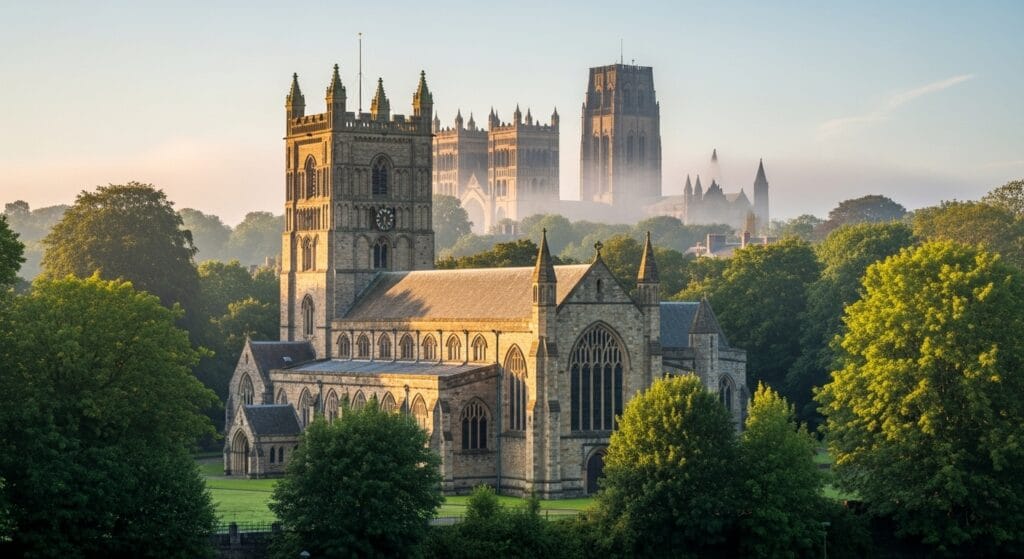
While Durham’s skyline is famously dominated by its magnificent Cathedral and Castle, the city’s sacred story truly begins on a quieter, more ancient patch of ground. Nestled on the leafy banks of the River Wear stands St. Oswald’s Church, a place of profound historical significance that predates the UNESCO World Heritage site it overlooks. It is a site woven into Durham’s very creation myth, a place of miracles and memory.
This guide delves into the thousand-year story of what is arguably Durham’s most important parish church. We’ll journey from its Anglo-Saxon roots and the pivotal legend of the Dun Cow, through centuries of architectural change, to its vibrant life today. You’ll discover why St. Oswald’s isn’t just a charming church near the Cathedral, but the essential starting point for understanding the soul of Durham.
An Essential Guide for the Modern Pilgrim & Visitor
This section provides all the practical information you need to plan your visit to St. Oswald’s. The church remains a welcoming sanctuary, and its accessibility is a testament to its ongoing role in the community.
Planning Your Visit: Key Information
St. Oswald’s Church is beautifully located on Church Street, offering stunning views across the river to the Cathedral. It’s a short, scenic walk from Durham’s bustling city centre, placing it in direct dialogue with the World Heritage Site. For a completely seamless trip, consider arranging executive transport to drop you right at the door.
- Address: St. Oswald’s Church, Church Street, Durham, County Durham, DH1 3DQ, England.
- Parish Office Phone: +44 191 383 0830.
- General Enquiries: Contact can be made via the official church website or the “A Church Near You” portal.
Service Times & Opening Hours
The church maintains a regular pattern of worship and is typically open to the public for private prayer, reflection, and exploration.
- Sunday Holy Communion: The main parish service is every Sunday at 11:00 a.m. and lasts about an hour. It’s the worshipping heart of the parish, with coffee and fellowship afterwards at the St. Oswald’s Institute.
- Sunday Evensong: A traditional Evensong service takes place on Sundays at 6:00 p.m. During university term time, this often features a full choral setting.
- Mid-week Holy Communion: A quieter, reflective Book of Common Prayer service is held every Wednesday at 10:00 a.m.
- General Opening: For visitors, the church is usually open weekdays from approximately 9:30 a.m. until 5:00 p.m., or dusk if that’s earlier.
St. Oswald’s Church Durham Parking & Accessibility
The church is committed to being accessible to everyone.
- Parking: While there’s no dedicated car park, you can find metered on-street St. Oswald’s Church Durham parking on Church Street, Oswald Court, and Hallgarth Street. This is typically free in the evenings for those attending services or concerts.
Important: Do not confuse this with the “Church Street Garage” which is in Durham, North Carolina, USA! - Taxi Service: For guaranteed convenience, a local Durham taxi service can provide easy drop-off and pick-up.
- Accessibility: A permanent ramp ensures level access to the main south entrance. Inside, a hearing (induction) loop is available, along with large-print service booklets. While there is a toilet in the vestry, fully accessible toilets with baby-changing facilities are located in the St. Oswald’s Institute directly across the road. Assistance dogs are welcome.
| Feature | Details |
| Address | Church Street, Durham, County Durham, DH1 3DQ |
| Phone | 0191 383 0830 (Parish Office) |
| Key Service Times | Sunday Holy Communion 11:00 a.m.; Sunday Evensong 6:00 p.m. |
| Weekday Opening | Approx. 9:30 a.m. – 5:00 p.m. (or dusk) |
| Parking | Metered on-street parking on Church Street and nearby |
| Main Accessibility | Permanent ramped entrance; hearing loop; accessible toilets at Institute |
The Deep Roots of St. Oswald’s: A Story Older Than the Cathedral
The story of St. Oswald’s Church isn’t an add-on to the Cathedral’s history; it’s the prologue.
Before the Normans: An Anglo-Saxon Sanctuary
Long before the Normans built their fortress of faith, a Christian community worshipped on this site. Compelling evidence points to a pre-Conquest, Anglo-Saxon foundation. Sculptured stones from this era have been found built into the church walls, and early maps show a distinctly circular churchyard—a common feature of ancient Celtic and Anglo-Saxon holy sites. This suggests a church, likely made of wood, stood here well before the Lindisfarne Community arrived in 995 AD.
The Legend of the Dun Cow: Where Durham Began?
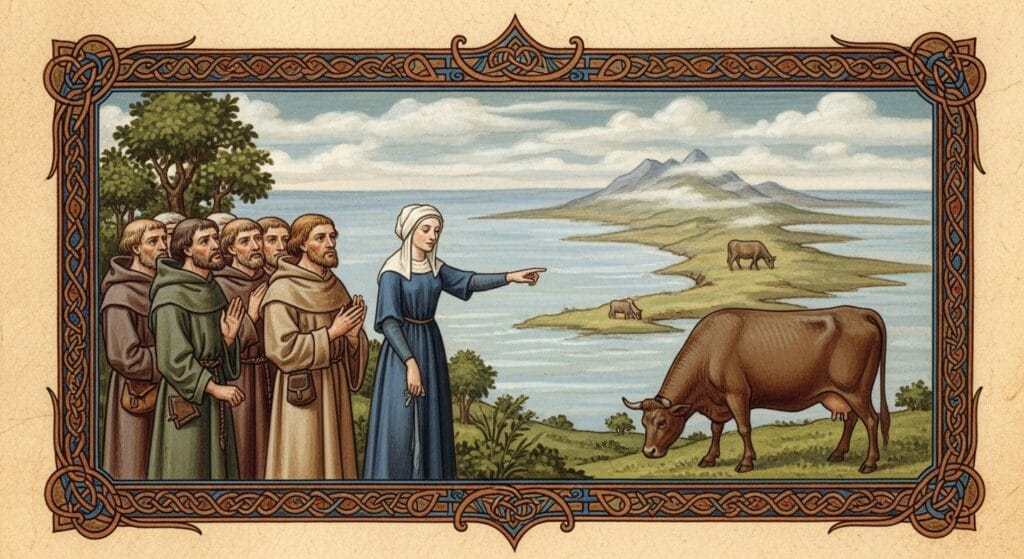
The church’s greatest claim to fame is its link to the origin story of Durham itself. In the late 10th century, monks carrying the sacred relics of St. Cuthbert were searching for a final resting place for their saint. Legend says that as they neared the peninsula, the coffin suddenly became miraculously immovable.
This divine sign is believed to have happened at or very near the site of St. Oswald’s Church. After a three-day fast, a monk had a vision telling him to take Cuthbert’s remains to ‘Dun Holm’. The problem was, no one knew where that was. The answer came from a milkmaid searching for her lost dun (brownish-grey) cow, who was heard saying she’d last seen it at Dun Holm. She led the monks to the high, defensible peninsula, where they built a shrine that would eventually become the magnificent Durham Cathedral.
An Architectural Journey Through Time
The building itself is a physical document, telling the story of Durham’s evolution through stone and glass.
The Norman Foundation (12th Century)
The oldest visible parts of the current church date to around 1180. These Norman features include the grand chancel arch, which rests on capitals carved with a distinctive “waterleaf” motif. The four eastern bays of the nave arcade, with their sturdy round columns, also belong to this first stone church.
Medieval Expansion (14th-15th Centuries)
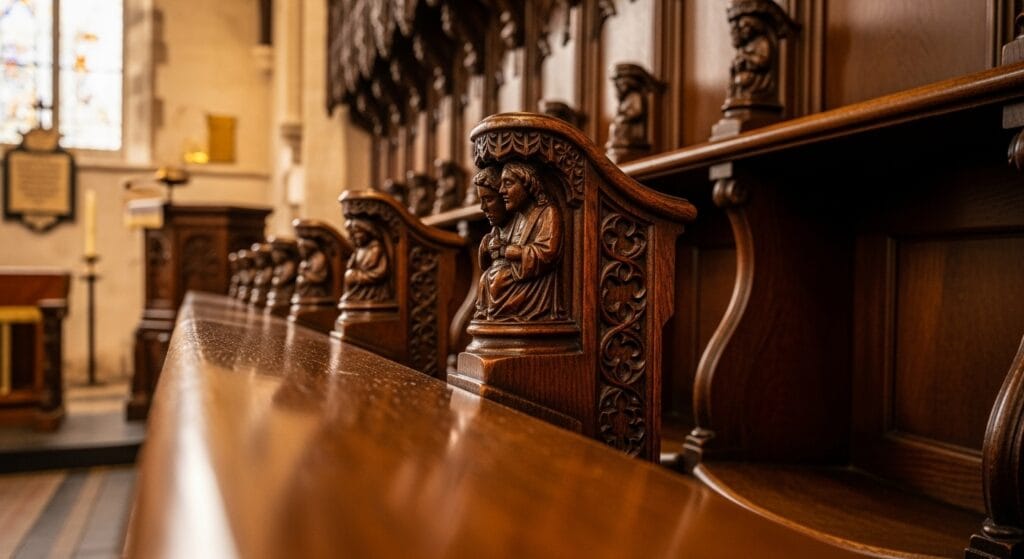
As Durham grew, so did St. Oswald’s. The chancel was extended and the north aisle widened. The impressive four-stage west tower, which defines the church’s silhouette, was added in the 15th century. Look up at the roof to see carved wooden angels and grotesque masks from this period, and admire the finely crafted 15th-century choir stalls, still in use today.
The Great Reconstructions (19th Century)
By the 1800s, the ancient church was suffering from decay and mining subsidence. This led to a major reconstruction in 1834 by architect Ignatius Bonomi, famous for his work on the Stockton and Darlington Railway. Just thirty years later, in 1864, another restoration by Hodgson Fowler rebuilt the tower and chancel again. These two Victorians are largely responsible for the church’s present external appearance, wrapping the medieval core in a Gothic Revival style.
| Period | Key Developments | Surviving Features |
| Pre-Conquest (c. 7th-10th C.) | Likely wooden church on a sacred site. | Anglo-Saxon carved stone fragments; circular churchyard plan. |
| Norman (c. 1180) | First major stone church built. | Chancel arch with waterleaf capitals; east bays of nave arcade. |
| Late Medieval (14th-15th C.) | Expansion to accommodate a larger congregation. | West tower; 15th C. choir stalls; medieval roof carvings. |
| Victorian (1834 & 1864) | Major reconstructions due to subsidence and decay by architects Ignatius Bonomi and Hodgson Fowler. | Current exterior appearance; south aisle; clerestory. |
| Modern (20th C.) | Restoration and additions, including new organ and windows. | Peter Collins organ; 1970s Creation window. |
The Treasures of St. Oswald’s: Art, Music, and Memory
The church houses artistic and historical treasures of national importance.
Light Through Glass: The Windows of Morris & Co.
The stained glass collection is exceptional. The highlight is the magnificent west window (1864-66) created by Morris & Co., the firm of Arts and Crafts leader William Morris. Several panels were designed by the celebrated Pre-Raphaelite painter Ford Madox Brown, making the church a must-see for art lovers.
A Musical Legacy: John Bacchus Dykes and the Phoenix Organ
St. Oswald’s is famous for its music, a tradition embodied by its most famous vicar, John Bacchus Dykes. He composed tunes for beloved hymns like “Jesu, Lover of my Soul” and “Eternal Father, Strong to Save” (the Navy Hymn). His grave is in the park across the road.
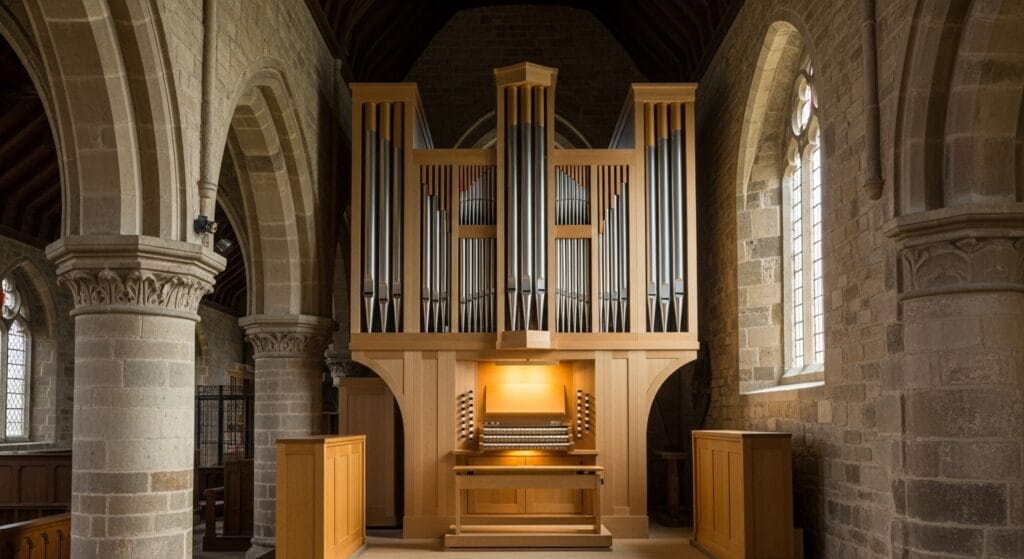
This legacy faced disaster on Ash Wednesday 1984, when an arson attack destroyed the historic organ. From the ashes rose a story of resilience. The community rallied, and in 1988 a superb new organ by Peter Collins was installed, a testament to the church’s unbreakable spirit.
The Peal of Bells: A Voice Since 1553
Bells have rung out from the tower since at least 1553. Two historic bells from a 1694 peal are now displayed inside the church. Today’s sound comes from a fine peal of eight bells cast in 1977 by John Taylor & Co., which are rung regularly for services.
In Grateful Remembrance: The War Memorial
In the churchyard, a Calvary cross honours parishioners who died in the First World War. In 2009, two bronze plaques with the names of the fallen were stolen. In a powerful act of defiance, the community commissioned precisely similar plaques, which were installed in 2010, ensuring the sacrifice is never forgotten.
The Saints of the Sanctuary: Oswald, Cuthbert, and the Prince Bishops
To understand St. Oswald’s is to understand the unique triangle of power that defined early Northumbria.
Who Was St. Oswald? The Warrior King of Northumbria
St. Oswald was a 7th-century warrior-king of Northumbria. A convert to Christianity, he invited St. Aidan to establish the monastery at Lindisfarne. He was killed in battle against the pagan King Penda of Mercia in 642 and was quickly venerated as a martyr and saint.
An Inseparable Bond: Oswald’s Head and Cuthbert’s Coffin
The connection between St. Oswald and St. Cuthbert is profound and macabre. After Oswald’s death, his head was recovered and, for safekeeping, placed inside St. Cuthbert’s coffin. When Cuthbert’s relics were moved to the new Durham Cathedral in 1104, Oswald’s head was found interred with him. This is why St. Cuthbert is often depicted holding St. Oswald’s crowned head, forging an unbreakable link between this church and the Cathedral.
Power and Parish: The Era of the Prince-Bishops
Following the Norman Conquest, the Bishops of Durham were granted semi-regal powers, becoming “Prince-Bishops.” They could raise armies, mint coins, and administer their own laws, ruling a buffer state against Scotland. Their authority was derived from being guardians of the “Patrimony of St. Cuthbert.” St. Oswald’s Church existed within this unique framework of martyr-power (Oswald), spiritual power (Cuthbert), and temporal power (the Prince-Bishops).
The Beating Heart of a Modern Community
Far from being a museum, St. Oswald’s is a vital hub for modern Durham.
A Tradition of Worship and Welcome
The church is consistently described as a “reservoir of peace.” It’s consciously inclusive, with a play corner for young families. The community spirit continues after services with refreshments at the St. Oswald’s Institute.
A Centre for Music and the Arts
Music remains central to the church’s identity. A high-standard SATB choir leads worship, and an active group of bell ringers continues a centuries-old tradition. Its excellent acoustics also make it a popular concert venue, often featuring students from Durham University. Attending a concert is a wonderful reason to visit, and you can see what’s on in our guide to upcoming events in Durham this July 2025.
Community Life and Outreach
The church publishes a 40-page parish magazine and the Institute hosts numerous community groups. It also plays an active role in social outreach, acting as a collection point for the Durham Foodbank and supporting those in need.
Beyond the Church Walls: A Historic Durham Walk
A visit to St. Oswald’s is the perfect start for a beautiful and historic walk.
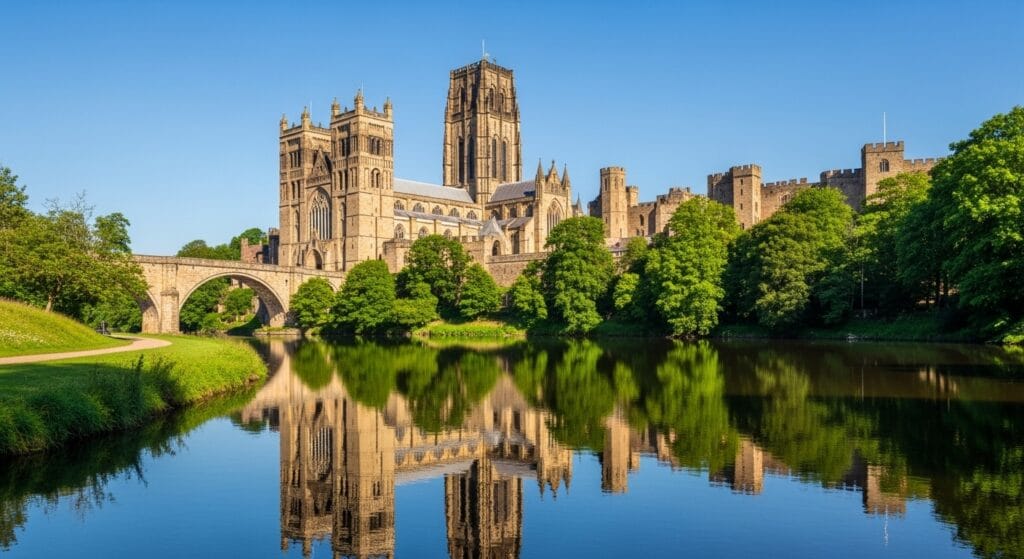
The Riverside Path to Prebends’ Bridge
From the churchyard, a path leads down to the River Wear. This walk reveals the most iconic view in England: the spectacular panorama of Durham Cathedral and Castle. The path takes you to the 18th-century Prebends’ Bridge, another classic viewpoint.
A Stone’s Throw from Greatness: The Cathedral and Castle
The walk from St. Oswald’s leads directly to Durham’s greatest treasures. Visit the tombs of St. Cuthbert and the Venerable Bede. Nearby, Durham Castle, a former home of the Prince-Bishops, can be visited by guided tour. If you’re planning an overnight trip to see these sights, be sure to check out the top hotels to stay in Durham.
St. Oswald’s Well: A Lost Holy Site
For the adventurous, a historical mystery lies hidden on the steep bank below the church: the site of St. Oswald’s Well. This holy well is a cavern cut into the sandstone cliff. Access is now very challenging and not recommended, but its story adds another layer of ancient intrigue to the sacred landscape.
Frequently Asked Questions about St. Oswald’s Church, Durham
What is the history of St. Oswald’s Church in Durham?
St. Oswald’s is likely Durham’s oldest parish church, with Anglo-Saxon roots in the 7th century. The current stone building dates from the late 12th century (Norman), was expanded in the Middle Ages, and significantly rebuilt in the 19th century due to mining subsidence.
Who was St. Oswald?
St. Oswald was a 7th-century Christian warrior-king of Northumbria. He was instrumental in bringing Christianity to the region. He was killed in battle in 642 and venerated as a saint and martyr.
How is St. Oswald’s connected to Durham Cathedral?
The connection is central to Durham’s founding. St. Oswald’s is believed to be where the monks carrying St. Cuthbert’s body were miraculously stopped, leading to the discovery of “Dun Holm,” the site of the Cathedral. Additionally, St. Oswald’s head is interred with St. Cuthbert in the Cathedral.
Can you visit St. Oswald’s Church? What are the opening times?
Yes, the church welcomes visitors. It is generally open on weekdays from around 9:30 a.m. to 5:00 p.m. (or dusk). Visitors are also welcome at services, including the main Parish Eucharist at 11:00 a.m. on Sundays.
Is there parking at St. Oswald’s Church in Durham?
There isn’t a private car park, but you can find metered on-street parking right outside on Church Street and on adjacent streets like Oswald Court. Parking is usually free in the evenings. For total convenience, consider booking a taxi.
What are the service times at St. Oswald’s?
The main services are Sunday Holy Communion at 11:00 a.m., Sunday Evensong at 6:00 p.m., and a mid-week Holy Communion on Wednesdays at 10:00 a.m.
What famous people are associated with St. Oswald’s Church?
The church is linked to famous figures like the Victorian hymn-writer John Bacchus Dykes (a former vicar), artist William Morris and painter Ford Madox Brown (whose work is in the west window), and the noted 19th-century architect Ignatius Bonomi.
