


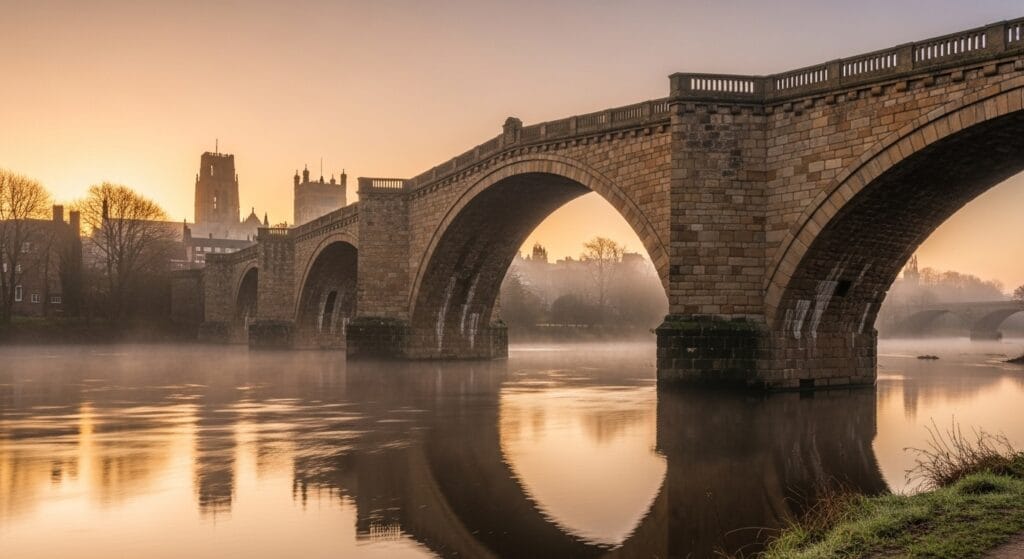
More than just a way to cross the River Wear, Elvet Bridge is a medieval street captured in time. It stands as a silent guardian of Durham’s history, having watched over the city from the heart of its UNESCO World Heritage Site for centuries. This Grade I listed structure isn’t merely an architectural relic; it’s a treasure trove of stories.
Elvet Bridge has been a stage for commerce and conflict, worship and imprisonment. It’s a landmark that continues to define Durham’s character today. This guide will take you on a comprehensive journey through its 850-year story, exploring its rich history, incredible architecture, forgotten legends, and modern vibrancy. It’s the definitive account of one of Northern England’s most important medieval bridges.
The Birth of a Bridge: Why Was Elvet Bridge Built?
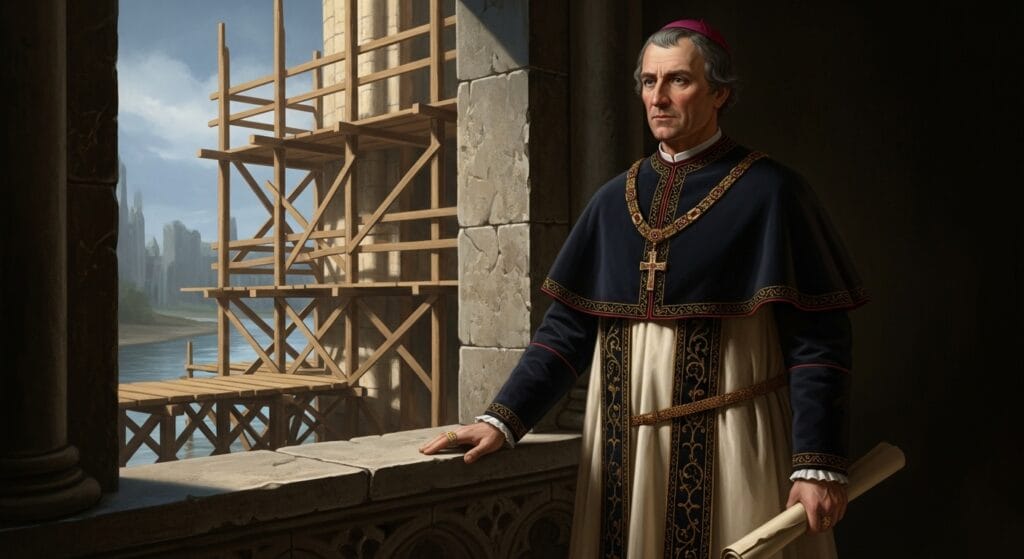
The story of Elvet Bridge starts with one of medieval England’s most powerful figures, Prince Bishop Hugh de Puiset, also known as “Bishop Pudsey.” Construction began around AD 1160 during his influential rule, a time of significant building projects across the north.
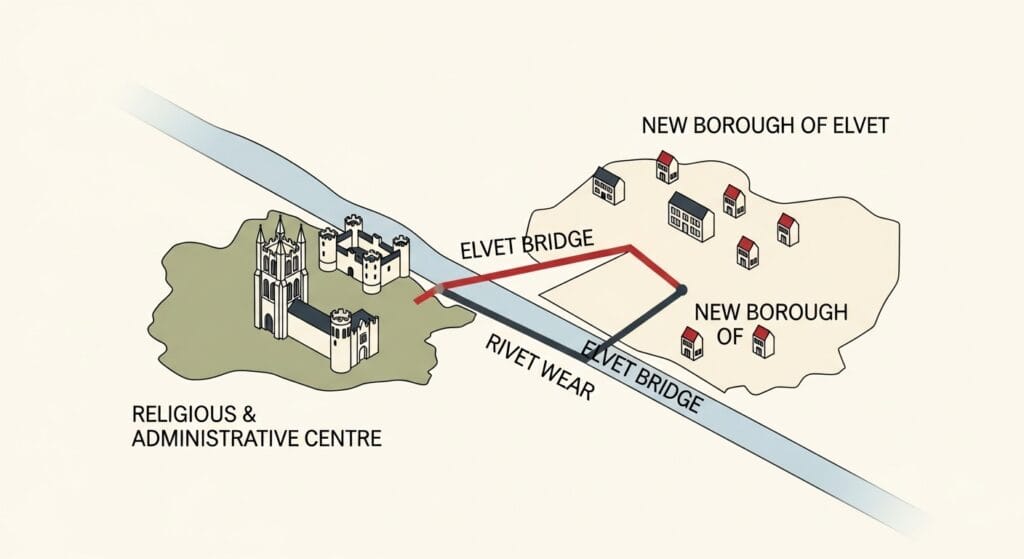
The main reason for this ambitious project wasn’t just to span the River Wear. It was a strategic move for urban development. Bishop Puiset was actively promoting the growth of a new settlement, the borough of Elvet, planned to house around 40 merchants. The bridge was the essential link connecting this new commercial hub with Durham’s established religious and administrative center on the peninsula.
The project’s massive scale and cost are clear from its lengthy construction time. Records from 1225 and 1228 show the church was still granting indulgences—a reduction of punishment for sins—to those who donated to the building fund. This highlights the bridge’s immense public and religious importance. Upon completion, it was called the “New Bridge” to set it apart from Durham’s first river crossing, the original Framwellgate Bridge.
An Architectural Marvel: Deconstructing Elvet Bridge
Elvet Bridge is a masterpiece of medieval engineering. Its architecture tells a story of evolution, from its 12th-century beginnings to major changes in the 19th century. Its design reflects function, resilience, and the challenges of its environment.
The Great Arch Debate: 10 or 14?
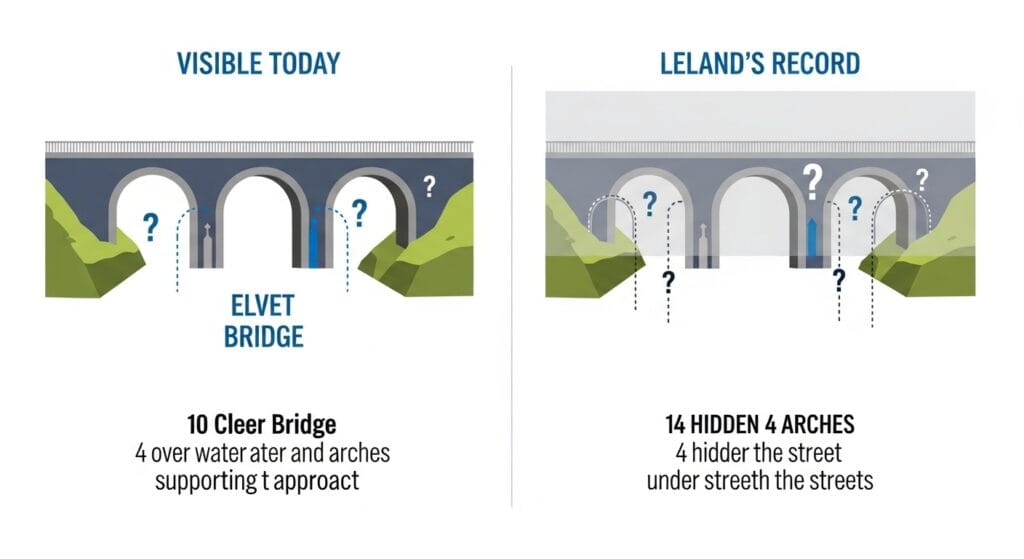
One of the most lasting questions about Elvet Bridge is its total number of arches. While ten are visible today, a historical note has fueled centuries of speculation. The 16th-century antiquarian John Leland recorded that the bridge had 14 arches, a claim that has never been definitively proven but remains a part of local lore.
Today, it’s understood that the River Wear flows through four main arches. The other six are “dry” or “land” arches, supporting the approach roads. It’s highly likely that extra arches are now hidden beneath the street level on the Elvet side or under the steep road known as Souter Peth. This clever design created a stable, raised causeway over the flood-prone riverbanks, showing the builders’ foresight.
The Bones of the Bridge: Materials and Design
According to its Grade I listing with Historic England, Elvet Bridge is a medieval masonry bridge made of coursed squared sandstone with ashlar dressings. Its design includes advanced features for its time, built to withstand the powerful currents of the Wear.
The bridge features pointed arches, a hallmark of Gothic architecture that provided more strength than the earlier rounded Romanesque arches. These arches are reinforced with prominent ribs on their undersides, which distribute weight more effectively. The piers supporting the arches are protected by sharp, triangular cutwaters designed to break the force of the water.
A Bridge of Two Eras: The 1805 Widening
A key moment in the bridge’s architectural story happened in 1804–05. To handle the growing traffic at the start of the industrial age, the bridge was significantly widened on its upstream (northern) side. Its width was expanded from about 15 feet to its current 33 feet.
This was a major modernization, not just a simple repair, and it fundamentally changed the bridge’s profile. When you stand on the bridge today, you can see the line where the 19th-century stonework meets the original medieval structure. This visible seam is a tangible record of Durham’s growth and the bridge’s adaptation to the city’s changing needs.
The Living Bridge: A Medieval Street Over Water
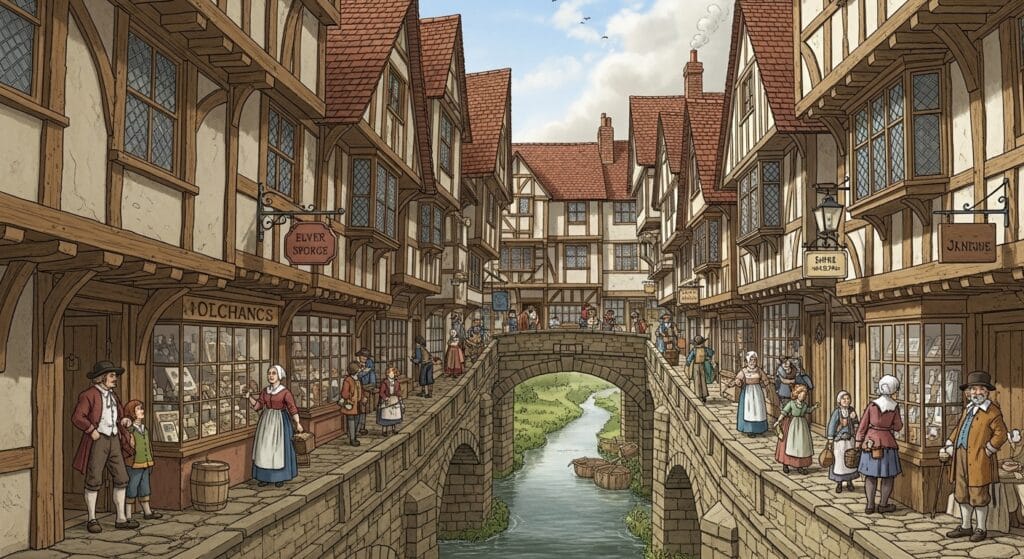
To see Elvet Bridge as just a piece of infrastructure is to miss its most fascinating story. For much of its history, it was a “living bridge”—a busy, inhabited street suspended over the water. This narrow path was a microcosm of medieval city life, filled with places of worship, shops, and even a prison.
Places of Worship and Correction: The Two Chapels and a Prison
Reflecting the era’s deep piety, Elvet Bridge originally had a chapel at each end. At the eastern, Elvet end, stood the Chapel of St. Andrew, founded in the late 13th century. At the western, city end, was the Chapel of St. James. These chapels were spiritual gateways where travelers could pray and give alms for the bridge’s upkeep.
The fate of these chapels shows the bridge’s changing role. In 1632, St. James’s Chapel was converted into a House of Correction, a city prison. This shift from a sacred space to a place of confinement starkly reflects the changing social priorities of the 17th century. The prison was torn down in the 18th century, but a chilling reminder remains. If you look closely at the westernmost land arch, you can still see the iron grilles of the old jail cells in the stonework.
While St. Andrew’s Chapel also disappeared, a part of it has survived. The building at 96-97 Elvet Bridge is built on the chapel’s medieval foundations, and its lower masonry is believed to be original to the bridge.
A Commercial Hub: The Shops and Residents of Elvet Bridge
The Durham bridge was a prime spot for business. By 1347, records show several shops and stalls were built across it, with owners paying rent to Durham Cathedral Priory. It was home to merchants and artisans, and by the mid-19th century, it had around 100 residents, though many lived on the immediate approach roads. Anyone planning a visit today to see the modern city’s commercial hubs can arrange a smart taxi booking service in Durham to explore with ease.
Life on the bridge was often dangerous. The river’s constant force made the buildings unstable. In 1760, several overcrowded houses on one of the piers were declared unsafe and demolished. A dramatic story from 1768 tells of a blacksmith who opened his shop door only to watch the floor collapse into the river, taking all his tools with it. The worst disaster was the Great Flood of 1771, which destroyed the three central arches and swept away numerous houses, claiming lives and livelihoods.
Ghosts of the Bridge: The Legends of Elvet
An ancient structure like Elvet Bridge is bound to have its share of folklore and ghost stories. These tales, passed down through generations, add another layer to its rich identity.
The Lost Musician: The Tale of the Disappearing Wait
A piece of folklore from 1879 tells of a mysterious disappearance. The story goes that on an unlucky Friday, one of the city’s official musicians, known as a “wait,” vanished without a trace at the foot of Elvet Bridge. After this strange event, the waits of Durham reportedly never played in the city on a Friday night again.
The Piper’s Lament: The Ghost of Jimmy Allan
The bridge’s most famous legend is the tragic tale of James “Jimmy” Allan, a renowned Northumbrian piper who was also a criminal. Allan was a notorious character, known for stealing horses and livestock.
His life of crime ended in 1803 when he was sentenced to death. Although his sentence was changed to transportation for life, his age and poor health meant he was instead imprisoned in the House of Correction in a land arch of Elvet Bridge. He died there in his cell in November 1810 after seven years of confinement.
The story has a deep sense of tragic irony. A royal pardon arrived for Allan from the Prince Regent, but it was too late—death had already claimed him. Legend says Jimmy’s spirit never left his prison. On dark, quiet nights, some say the faint, sad sound of his Northumbrian pipes can still be heard echoing from beneath the arches, a lament for a life lost and a freedom that came too late.
A Visitor’s Guide to Elvet Bridge Today
Today, Elvet Bridge is a peaceful, pedestrian-only walkway offering some of Durham’s most beautiful views. It’s both a destination and a gateway to exploring the historic city. A visit here is a key part of many upcoming events in Durham this month, July 2025, providing a scenic route between venues.
How to Visit and What to See
The bridge connects the Saddler Street and Market Place area with the Elvet district. It’s a perfect spot for historical discovery. For those staying in the city, many of the top hotels to stay in Durham are within easy walking distance.
A spotter’s guide to the bridge’s hidden details:
- The Prison Bars: Look for the iron grilles set into the stonework of the westernmost land arch, the last remnant of the 17th-century jail.
- The Chapel Remnants: Observe the gabled building at 96-97 Elvet Bridge and, from the riverbank, the exposed medieval masonry of St. Andrew’s Chapel.
- The 1805 Widening: Notice the visible seam in the stonework on the upstream (north) side, where new meets old.
- The Surviving Rounded Arch: Beneath the gabled building on the Elvet side, one of the original, rounded 12th-century arches might still be visible.
The Best Photo Spots
Elvet Bridge is incredibly photogenic. For the best views, explore these vantage points:
- From the Riverbanks: The paths along the Wear offer classic shots that highlight the arches’ scale and beauty.
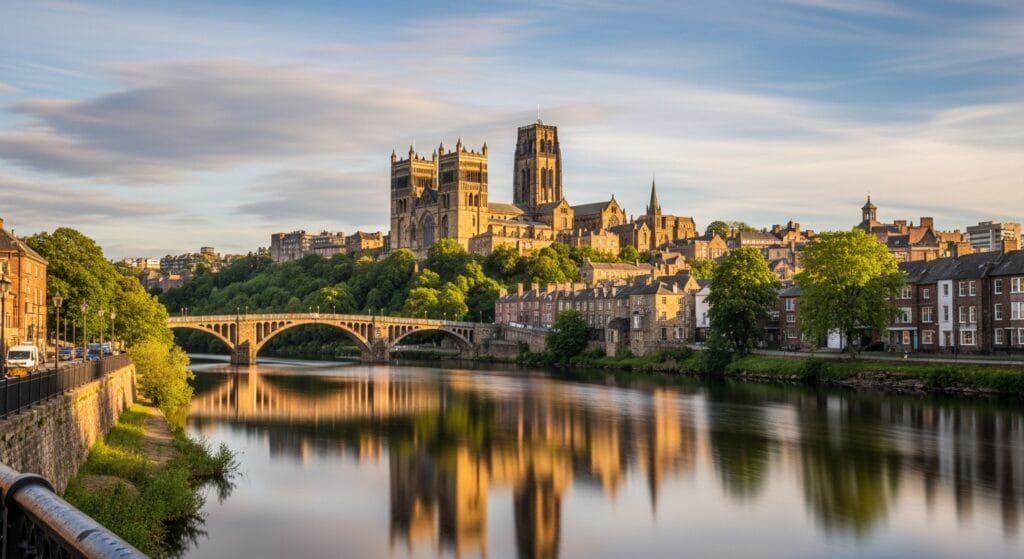
- From Prebends’ Bridge: Further upstream, Prebends Bridge provides the iconic panoramic view, capturing Elvet Bridge, Framwellgate Bridge, and the magnificent Durham Cathedral in a single frame.
- On the Bridge Itself: Standing mid-span offers stunning views of the river, rowers, and the approach to Durham Castle.
Pubs, Cafes, and Restaurants on and around Elvet Bridge
The area around Elvet Bridge is a vibrant hub for food and drink, with many places offering outdoor seating on the pedestrianized street. For visitors needing to get to and from this bustling area, a reliable taxi service can make the journey simple.
| Name | Type | Location | Note |
| The Swan & Three Cygnets | Pub | On Elvet Bridge | A historic pub with indoor and outdoor seating offering classic pub fare. |
| Tin of Sardines | Gin Bar | 18 Elvet Bridge | A tiny but famous bar renowned for its extensive and creative gin selection. |
| Tealicious | Tea Room | 88 Elvet Bridge | A quintessential English tea room perfect for afternoon tea and light bites. |
| Zapatista Burrito Bar | Burrito Bar | 87 A&B Elvet Bridge | A popular spot for casual Mexican food like burritos, tacos, and nachos. |
| Chapters of Durham | Tearoom & Kitchen | 16 Elvet Bridge | Offers a mix of tearoom classics, meals, and an ice cream parlour. |
FAQ: Your Questions About Elvet Bridge Answered
How old is Elvet Bridge in Durham?
Construction on Elvet Bridge started around AD 1160, making it approximately 865 years old as of 2025. While one arch may date from this period, most of the surviving medieval structure was finished in the early 13th century.
What is the oldest bridge in Durham?
The oldest bridge in Durham is Framwellgate Bridge, built around 1128 by Bishop Ranulf Flambard. Elvet Bridge is the city’s second oldest surviving bridge.
Can you drive over Elvet Bridge?
No, Elvet Bridge is now pedestrianized and closed to general traffic. It’s a key part of the city’s walking routes. If you need to travel across the city, you can easily book a taxi online for convenient transport.
Is Elvet Bridge haunted?
Local legend claims Elvet Bridge is haunted by the ghost of Jimmy Allan, a piper who died in a cell beneath the bridge in 1810. His ghost is said to be heard playing his pipes on quiet nights.
How many arches does Elvet Bridge have?
The bridge has 10 verified and visible arches. However, a 16th-century account claimed it had 14, leading to speculation that four more arches are hidden under the modern streets at each end.
Note:
Elvet Bridge is far more than stone and mortar crossing a river. It is a living document of Durham’s history, embodying the ambition of Prince Bishops, the hustle of medieval commerce, the severity of 17th-century justice, and the power of local folklore. Its architectural journey mirrors the growth of the city it serves.
Understanding Elvet Bridge comes from seeing it not as a static object but as a medieval street with a life of its own. This perspective connects the prayers in its chapels, the goods sold in its stalls, the sentences served in its prison, and the lament of its resident ghost into one compelling story. It encourages every visitor to look beyond the beautiful facade and see the layers of human experience in its ancient stones, making any walk across its span a journey through 850 years of history.
